
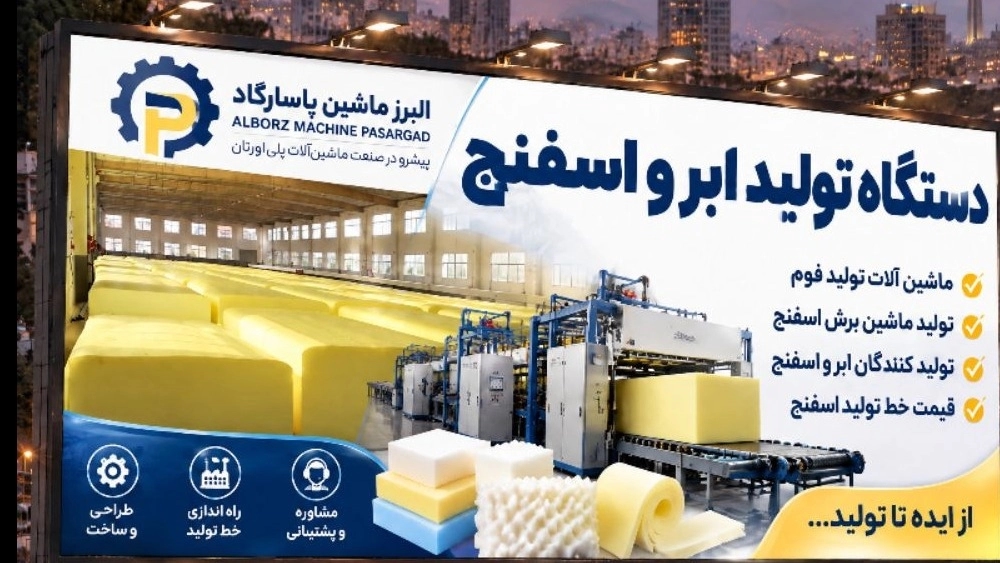
The cloud and sponge production machine is one of the key equipments in the foam industry, which enables the production of soft and hard foam for applications such as furniture, mattresses, car seats, and even packaging. This device is designed in two continuous and non-continuous types and can be selected according to the manufacturer's needs. Alborz Machine Pasargad Company has high experience in providing sponge machines and raw materials and is considered a reliable option for setting up production lines. Compliance with technical points such as capacity, quality of parts and safety of the device is one of the 4 main factors in choosing it.
The sponge production machine is one of the important machines in the polyurethane industry, which enables the production of various sponges with different density and hardness. Depending on the needs of industries, this machine is designed in two types, continuous and discontinuous, and includes parts such as raw material tanks, injection and mixer systems, molds or conveyor belts, and cutting systems. Wide applications of this device include the production of mattresses, furniture, car seats, packaging and insulation. Strict formulation control and the use of automation systems guarantee the high quality of the final product.
Sponge material formula! This is where the science of chemistry and the art of production meet to create this soft and lovely material.
In general, the main ingredients of polyurethane sponge are as follows:
2. Isocyanate:
3. Blowing Agent:
- Main role: This substance is responsible for creating bubbles or "cells" in the structure of the sponge, which makes the sponge light and porous.
- Types:
- Water: The most common and environmentally friendly foaming agent. Water reacts with isocyanate to produce carbon dioxide (CO2), which is the blowing agent gas.
- Physical blowing agents: such as pentane or other hydrocarbons, which create bubbles by evaporation. These agents are used less often or are used with water.
- Effect: the amount of foaming agent directly affects the density of the sponge; The more it is, the lighter and softer the sponge becomes.
4. Catalysts:
- Main role: These substances control the reaction rate between polyol, isocyanate and water. Without a catalyst, the reaction will be very slow.
- Types: Usually, amine catalysts (such as Dabco) and tin catalysts (such as T-9) are used in combination.
- Effect: Catalysts regulate the reaction start time (creme time), rise time (rise time) and sponge drying time.
5. Surfactants:
- The main role: these materials help to stabilize the gas bubbles created by the foaming agent and prevent them from bursting so that a uniform cell structure is obtained.
- Types: Silicone surfactants are usually used.
6. Other additives:
- Flame Retardants: to increase the sponge's resistance to fire (especially in furniture and cars).
- Colorants: to create different colors in the sponge.
- Antioxidants: to prevent yellowing and destruction of the sponge against light and oxygen.
- Softeners: to increase softness. Sponge.
- Fillers: such as calcium carbonate, to reduce cost or change some physical properties.
What materials does the sponge consist of?
🔧 Features of the sponge device:
Description
Production capacity
Motor power 4 horses
2x3x2.5 meters
Electricity consumption
380 V three phase
Type of control
PLC and HMI
🧪 What materials does the sponge consist of:
Isocyanate - 30-40%
Water - 2-4%
Catalyst - 0.5-2%
Film Retardant - As Needed
📊 Sponge material formula:
- Polyol: 100 episodes
- TDI/MDI: 45-55 parts
- Amine catalyst: 0.2-0.8 parts